
I was talking to my granddaughter Emma last night. We were saying what a great thing it is that she is teaching at Faith Academy.
I know she loves her job and that the kids that she teaches love her.
I doubted that she had ever heard the story of the Horse in the Highway that happened right at the now entrance to Faith Academy, almost 60 years ago. I know it’s hard to believe, that my grandchildren don’t hang on every story and every word I write on The Angora Chronicles. But they come across it honestly. Neither do their parents. Even though I started writing my stories as a way to leave something behind of my life, for them there will be a time in the future possibility, where the stories will be more meaningfully.
Honestly I more write for myself, to help me re-live my past.
After I shared the story below, we talked more about how that blink of an eye could have changed the course of all of this generation of Lewis lives on into perpetuity. She said that’s the Butterfly Effect. I had heard that reference made but looked it up to be for sure what the meaning is.
The Butterfly Effect is the idea that very small changes in a system can lead to huge differences later on. It’s most often discussed in weather, physics, and chaos theory.
The Basic Idea 🦋
The classic explanation is:
A butterfly flapping its wings in Brazil could eventually influence a tornado in Texas.
It doesn’t literally mean a butterfly causes a tornado. Instead, it shows that complex systems are extremely sensitive to tiny starting changes. Even the smallest difference at the beginning can grow into a completely different outcome.
Where the Idea Came From
The concept was popularized by meteorologist Edward Lorenz in the 1960s. While running early weather computer models, he discovered that rounding a number slightly differently produced completely different forecasts later in the simulation.
This discovery became a cornerstone of Chaos Theory, which studies systems that look random but actually follow hidden patterns and rules.
Real-World Examples
Some areas where the butterfly effect shows up:
Weather forecasting – Tiny measurement differences can change a forecast days later. Ecosystems – A small change in one species can affect an entire food chain. Economics – Minor events can trigger large market shifts. History – Small decisions sometimes lead to huge historical consequences.
In Pop Culture 🎬
The concept became widely known through the film The Butterfly Effect, starring Ashton Kutcher. In the movie, tiny changes to the past dramatically alter the future.
The Key Takeaway
The butterfly effect teaches that:
Complex systems are unpredictable long-term Small causes can have huge consequences Perfect prediction is impossible in many natural systems
In other words: little things can matter a lot.
Now for my original story:
A Horse in the Highway
I was driving my first car, a 1963 Ford Galaxie. Before buying that car I had driven whatever vehicle happened to be sitting around. In those days there were several to choose from—it looked like a used car lot in front of our house.
The year was 1967. I was almost 15.
After closing down the Texaco—my first job outside of working for my dad—I drove up and down the street until it looked like everyone had headed home. Then I started out for the nine-mile trip to Smithwick. It was early to be heading home, probably around 11:00 PM. I remember it being a bright moonlit night.
The first long straight stretch started just after passing the turnoff to Fry’s Camp. Feeling the freedom and the power of that 390 CI Ford engine, I pushed it up to about 90 mph as I passed the Eskew place. It was going to be a fast trip home.
As I approached what is now Faith Academy, my headlights dipped as the road dropped off slightly. When they came back up, all I could see was a horse standing broadside in my lane.
It was no more than 60 or 70 yards in front of me.
Instinctively, I jerked the wheel left into the westbound lane and then just as quickly back to the right. Somehow I did it without ever locking up the brakes—which should have been my first reaction. To this day I don’t know how a kid with so little driving experience pulled that off. The drop-offs on either side of the road were steep, and going off either one would not have ended well.
Miraculously, I stayed on the road.
By the time I crossed the Hamilton Creek bridge I had slowed to about half my original speed. One thought kept flashing through my mind: Why was a horse standing in the road?
What stuck with me most was that the horse was saddled and just standing there.
Just past my Aunt Marie Bible’s driveway I came upon several more horses with riders. They were from Camp Peniel, a kids’ camp a couple of miles farther down the road. I stopped and asked them about the horse that had nearly caused my death.
They told me the horse had hurt its foot and was limping, so they had gone back to camp to get help. Yes, they had left it standing in the road where they thought it would be safest.
As I later realized, they were camp counselors on their night off between groups of campers—probably high school kids from the city, just out for a leisurely ride and doing the best they knew how with the situation.
But I made them—yes, made them—go back and get that horse and tie it to a fence post. Then I drove back and sat there with my flashers on until it was moved.
At that speed, a horse coming up over the hood and through the windshield would not have been survivable.
If there was ever a time in my youth that I was certain an angel was sitting on my shoulder, it was that night.
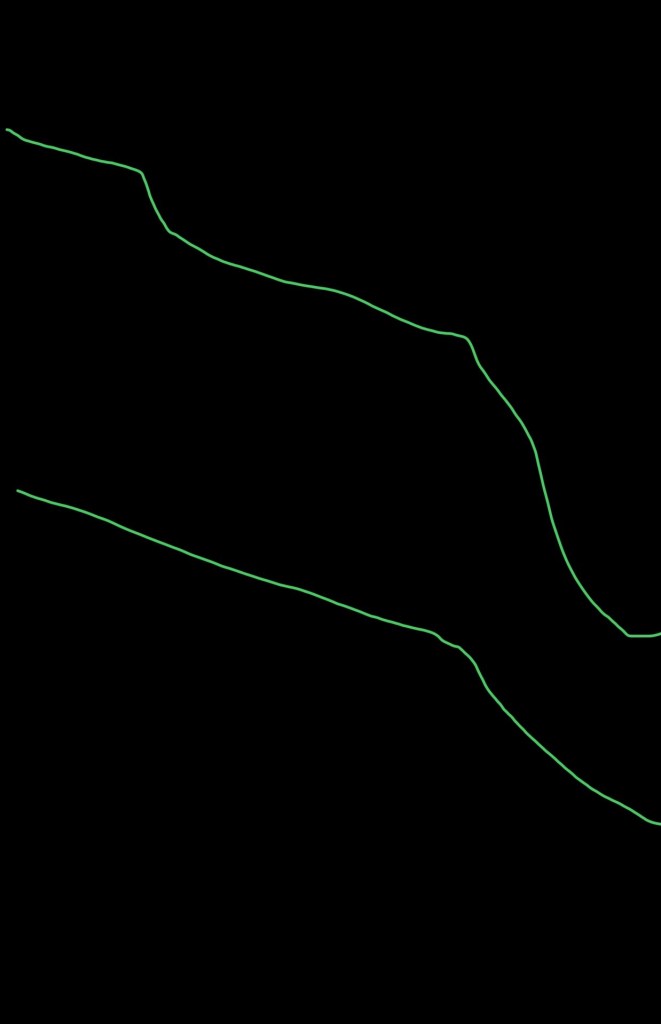
The top line shows how the road profile looked in the earlier days, while the bottom line depicts more the way it looks after a major highway rebuilding in the 1980s, from the Warren Lyda driveway to Hamilton Creek.
 Angora Chronicles