
This isn’t an actual story. It is the notes that I made to read off of while I gave a talk at The Falls on the Colorado Musuem last Saturday June 3, 2023.
A fellow said to me before I gave this talk: ”You ain’t gonna claim you used to cut cedar are you? How are you going to get up and talk about it?”
I said “I talk about things all the time I’ve never done, thankfully.”
Good morning everyone . I am here today to talk about Cedar Choppers.
Primarily the Central Texas Cedar Chopper.
Hasn’t The Museum done a great job with this Cedar Chopper Display, as well as the many other great things it has done over the years?
I am Ronnie Lewis . I was raised here in Marble Falls and graduated from Marble Falls HS in 1970.
My wife, Madeline, also graduated from here that same year. We we married in the fall of 1971.
We went on to have five sons and now have 11 grandchildren and 3 great grandchildren.
We moved off to Austin in 1972 and have spent the past 51 years in the underground utility construction business, starting that business also in 1972.
We currently live in Bertram, where are we have been a part of the community for 30 years.
I spend much of my time writing and telling stories about what growing up was like in the 1950s and 60s, along with stories from the more than 50 years in the construction business.
Those stories translated into a book that published a few years ago with some 67 stories that I had told on my Facebook group, named The Angora Chronicles.
Since about 2015 those 67 stories have grown to more than 1500 such stories and local history items that have appeared on that FB Group and my blog spot AngoraChronicles.com for the non-Facebookers.
Much of my focus now is encouraging others to write your stories. Leave a little something of you behind. If you don’t tell your story, probably no one else will.
My family has been in Smithwick since the mid-1800s.
Both my Dad’s family, the Lewis’s.
And my mothers family, the Boultinghouse’s.
The Lewises were involved in cutting cedar, but I suspect it was mostly for their own use.
My grandfather, Oscar Delbert Boultinghouse, the fellow setting on the running board of the old cedar chopper truck in the photograph in the display collage the back of the room.
His youngest son Stanley is standing beside him in that photo. He was the younger of the Boultinghouse sons.
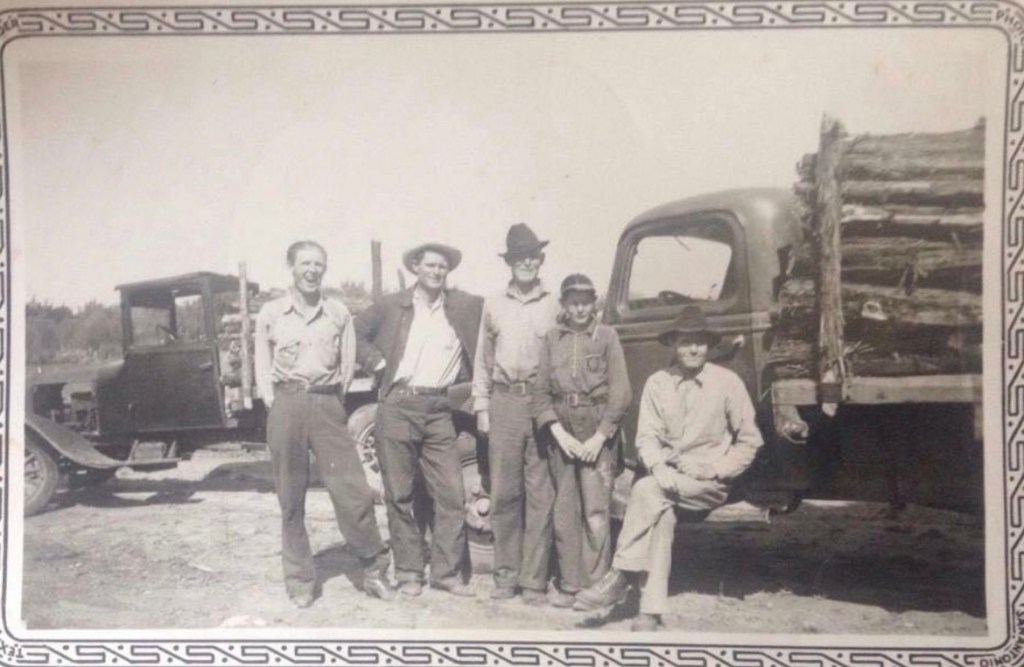
My grandpa always went by Delbert. He was a Cedar Chopper for most, if not his whole adult life.
He pretty well lived off the land, cutting cedar, and also operated a molasses mill just east of Smithwick on the family homestead.
In the early part of World War II, Delbert, went off with other family members to Arkansas.
They were cutting timber to build bridges as part of the war effort. While working there he had an accident that cut off one of his legs.
He and my grandmother, Nancy had 11 kids. Eight girls and three boys. My mother was the 5th of 8 girls.
After his accident, he returned to Smithwick, but his health never was very good after that, and he died at the age of 51, in 1942.
Several of the family members continue on chopping cedar during and after the war to help my grandmother feed all those children.
Of course I never did know my grandpa. My mother was only nine when he died.
My grandmother, Nancy’s father was also in the Cedar business in Burnet. His name was Jim Martin. He is the very tall gentleman in the picture in the back of the room, standing next to a stack of posts at a cedar yard in Burnet.
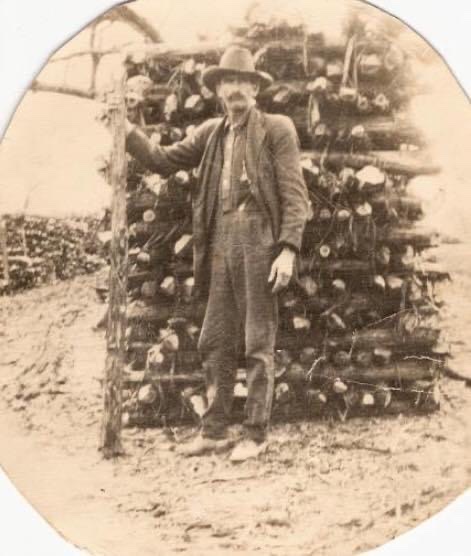
He was a long tall lanky fellow. Some claim that he was almost 7 feet tall. That may be a slight exaggeration, but from the picture he does appear to be taller than the average man of that time.
He died in 1936 at the age of 70.
I missed out on the joys chopping cedar.
Well almost. My brother, Kenny – 2 1/2 years older than me and I contracted to cut and put new stays in the neighbors fence in Smithwick in about 1963.
That gave me just enough cedar chopping to realize there were easier ways to make a living. I guess I thought digging ditches for a living was much easier. So much for that.
Cedar Chopping was always hard work but that could be traded for an honest living and it made an man self employed. You were your own boss.
It is said that many Cedar Choppers were hard living & hard drinking individuals, and many of them like to fight.
There are many tales of Cedar Choppers going into the beer joints out south of town at the Blanco County Line. It often didn’t take long for a fight to break out.
Probably the place that was the best known for that to happen was the Lazy A. That place certainly had a reputation.
When I was four years old, my family left Smithwick and moved to Jollyville, making it possible for my dad to earn a living in Austin.
We lived there until I finished the 7th grade.
We live down off of Bull Creek, where many Cedar Chopper families also lived, so we went to school and grew up with many Cedar Choppers kids.
Many people looked down on those families as being of a lower class on the social rung of the ladder.
I can’t say that I ever looked down on them. We were just one generation removed from being cedar choppers.
The Ken Roberts book, The Cedar Choppers, Life on the Edge of Nothing covers a lot about Cedar Chopper families along Bull Creek and other locales just out of Austin.
That book is very good at describing the life of a Cedar Chopper.
It didn’t cover very much about the Cedar business and families in Burnet, Llano, Blanco and Lampasas counties. But it’s an excellent book on the subject.
Let’s talk about the cedar tree. It is actually the Ashe Juniper but to country folks, it’s a cedar tree.
There has been much debate about how beneficial Cedar’s are. I’m going to stay away from my personal thoughts about Cedars.
Besides, them making good fence posts and beautiful wooden furniture and stuff they never held much for me personally.
There has been much study that went into the common cedar tree in this area and whether it “sucks up all the water or not”
There was a time when the bird people wanted to see all cedar trees protected as it was crucial habitat for the blacked cap vireo and the golden cheeked warbler.
The Balcones Canyonland Perserve worked for years to keep land owners from cutting scrub cedars off their land.
But now that group has prescribed burns to help control the cedars on the more than 33,000 acres of land they own. That group has really done a lot with environmental ecology.
Oh, did I mention the dreaded cedar pollen problem common to this area?
Most of the good Cedar had been cut and it was a dying trade by the time I came along.
Cedar Chopping goes back to 1800s but most cedar cutting took place in this area from the very early 1900s until the 1950s and 60s.
There was limited cedar harvesting done in the 70s and 80s, with some cedar still being cut nowadays. It is mostly used by local fence builders.
There are still a few Cedar Yards in the area.
When I was growing up in the 50s and 60s, they were three operating cedar yards in Marble Falls
The Callahan cedar yard was a block off of 281 at Forth street. Behind were the PNC Bank is now.
The Nobles Cedar Yard was located where Burger King is now.
A 3rd one was out on top of the hill south of town, across from where Max Starkey Dam Road leads off. Westlake Dermatology has a facility there . That was the Jay’s Cedar Yard.
There was a grading system for the size, straightness and quality of cedar posts.
Old growth cedar was preferred. The more heart, or the red part of a post, the better.
The outer white soft wood, generally rots away quickly.
The heart wood lasts for decades.
Cedar stays are generally 2 inches and smaller and 5 to 6 feet long.
They are wired in the place to keep the wires separated, and give rigidity to the fenceline.
Line Posts are generally 4 inches to 6 inches in diameter and spaced out 10’ to 12’ and buried 2 to 3 feet into the ground. Therefore, they need to be 7 to 8 feet long.
The corner posts are the big daddy of posts. They are more like 8” to 10 inches or even larger.
They are buried 3’ or more into the ground. That is where the wire stretching and pulling takes place. They need to be anchored in the ground very solidly.
Some people will tell you that a post cut with an ax is far superior to those cut with a chainsaw.
My best explanation about the differences an ax cut leaves a slick, sloping surface that doesn’t allow water to penetrate of the post.
A post cut with a chainsaw has a flat surface with slight grooves left by the chainsaw blade.
That allows water to enter the post more easily, hence, causing a post to degrade sooner.
And I have read about many Cedar Chopper families that also made charcoal from the cedar that didn’t make a good fence post. That all seems very plausible.
That was an activity that could be done by the women and children.
Whereas actual cutting, hauling out and loading cedar probably wasn’t very well suited for women and children.
This was done where wood was placed in a kiln and burned with low amounts of oxygen, leaving charcoal.
I never did hear of much charcoal being produced around here.
That was probably because there was a lot of live oak hardwood that was very suitable for burning in stoves, and fireplaces for heat, cooking and clothes washing.
I’m not discounting that it could have been done because people of that time wanted to use up every resource and not waste anything.
Another Cedar related enterprise was extracting Cedar oil that was used in a variety of ways.
1. Insect repellent
2. Air freshener
3. Antifungal
4. Anti-inflammatory
5. Aromatherapy
6. Skin care
7. Wood preservative
8. Natural cleaning agent
Overall, cedar oil is a versatile and useful natural product that has many benefits for both health and household uses.
There was an old gentleman just up the hill from us at Jollyville operated a Cedar mill, for distilling cedar oil from cedar stumps.
A process of heat and pressure was used to extract the oils.
There are still a few of the Cedar mills operating, but mostly out west of here.
Some people say cedar came into this area as a result of cattle drives coming up from the south, and even from down in Mexico. The cows supposedly ate the cedar berries, and scattered the seeds throughout this land.
I don’t necessarily ascribe to that idea. Much the old-growth Cedar was here prior to the cattle drives.
I personally think that cedar cutting and hauling cedar out of the pastures scattered seeds and caused much of the cedar migration.
The Scholten Railroad at Lometa……… 1912 -1920
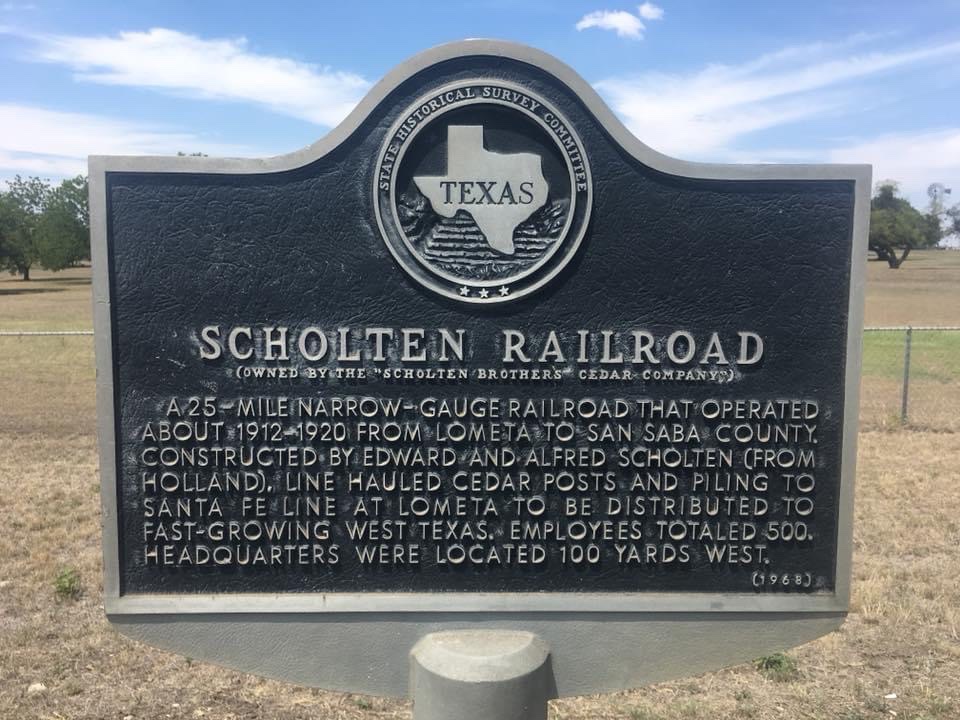
2 brothers from Holland built a 25 mile narrow gauge rail line from Lometa to near the upper end of what now Lake Buchanan.
Floods wiped out track and bridges a few times and most of the best cedar was cut during that decade.
So the line was abandoned and later taken up and sold for scrap.
There were many dangers being a Cedar Chopper. Besides swinging extremely sharp axes and chainsaws. They were always long distance from a doctor and hospital.
They were harsh, working conditions, both extreme heat and cold. I have heard it said how stifling it was down in Cedar breaks for not a bit of breeze could get through those cedars.
They were snakes and scorpions and many other critters that they came in contact with.
I heard there were various clans competing for the best cedar-breaks. Sometimes feuds break out.
There were cedar choppers and cedar cutters. These were recognized as a true professionals.
I also had cedar hackers and cedar whackers. These were probably less than professional types. Probably doing it on a temporary basis waiting and wanting something easier out of life.
When I was a kid, just up north of Jollyville was the little community of Cedar Park.
Cedar Park is now recognized as a very good and prominent place to live and do business.
Earlier on, it was mostly cedar yards and beer joints. It was a rough place.
During the 1970s and 80s they held the Cedar Chopper Festival each year.
It finally occurred to some of the city leaders that the Cedar Chopper Festival wasn’t very becoming of a town that was trying to be more respectable.
The Cedar Chopper Festival name was dropped in favor of the Cedar Park Heritage Festival.
Something worked to bring it into the 21st century as it is truly a happening place now.
At this time I’m going to open it up to questions.
This will give you an idea of what all was discussed. I am happy to answer and questions a person may have.
I will attempt to give you an answer.
Hopefully it will be fairly accurate.


Loved reading this! Your stories and my Grandson and to be Granddaughter are the only thing I miss from Facebook!
LikeLiked by 1 person