
Vol.21-No.4
February 20, 1969

Arrott Takes Rain And Shearing Crew Any Time They Come, Even Together
TENNYSON, Tex. -Monroe Arrott is shearing about 7000 Angora goats this winter, enough to place him well toward the top among Texas’ larger goat ranchers. He started shearing last Saturday during cold, damp weather even though forecasters predicted rain. These days, he says, he shears when he gets the crew. Almost half a century of goat ranching has taught him how to reduce death loss hazards to a minimum. He has two sheds big enough to shelter 2000 goats each on the Coke County ranch where he runs his mutton and dry nannies.
“The sheds have enough partitions and doorways to prevent the goats from crowding and piling up in cold weather,” he says. He recalls some disasters. When he started ranching on his own in 1924, he had a herd of goats on the Coke County ranch and another 1200 head on leased pasture in New Mexico. A cold rain came right behind the shearing crew. Next morning he could count only nine heads alive.
He simply got some more goats and started over. “The goat business is just like playing poker. When you freeze out, you draw a new hand and hope to get an ace in the hole.” He started over with 100 nannies bought at 25 cents a head and a few good billies at $75. “That re-start may have been the key to Arrott’s success as a goat rancher. He chose goats which had long fine hair and has stuck with that kind even when many registered breeders were striving for billies that would put coarser, heavier fleeces on their offspring. Today, fine hair is in and coarse hair is out.
Arrott constantly culls his 4000 head nanny herd, keeping only the fine haired ones for replacements. He keeps them so long as the hair stays fine, then sells them as age coarsens the fiber.
He’s seen mohair go up and down many times. He sold three clips at six cents a pound in 1932-33. “But I took the money from that mohair and paid cash for a section of good flat land in Tom Green County at $12 an acre. The same land would lost $200 now.”
Although mohair prices have advanced from depression levels, they are not as good now as when Arrott started in 1924. “I got 50-60 cents a pound that year.” Highest prices he ever received were $2.35 for kid and $1.90 for adult hair in the early 1950s.
Arrott runs goats and 200 Angus cows on a total of 29.5 sections. He keeps the kids and most of the cattle at his headquarters place on high, almost flat land in north Tom Green County near Tennyson. He runs muttons and dry nannies on the mountainous liveoak country in south Coke County and about 4000 nannies on a hilly oak-covered place near Christoval in south Tom Green. He runs the older goats on the Coke County place because they are able to protect themselves better against red foxes and bobcats prevalent there.
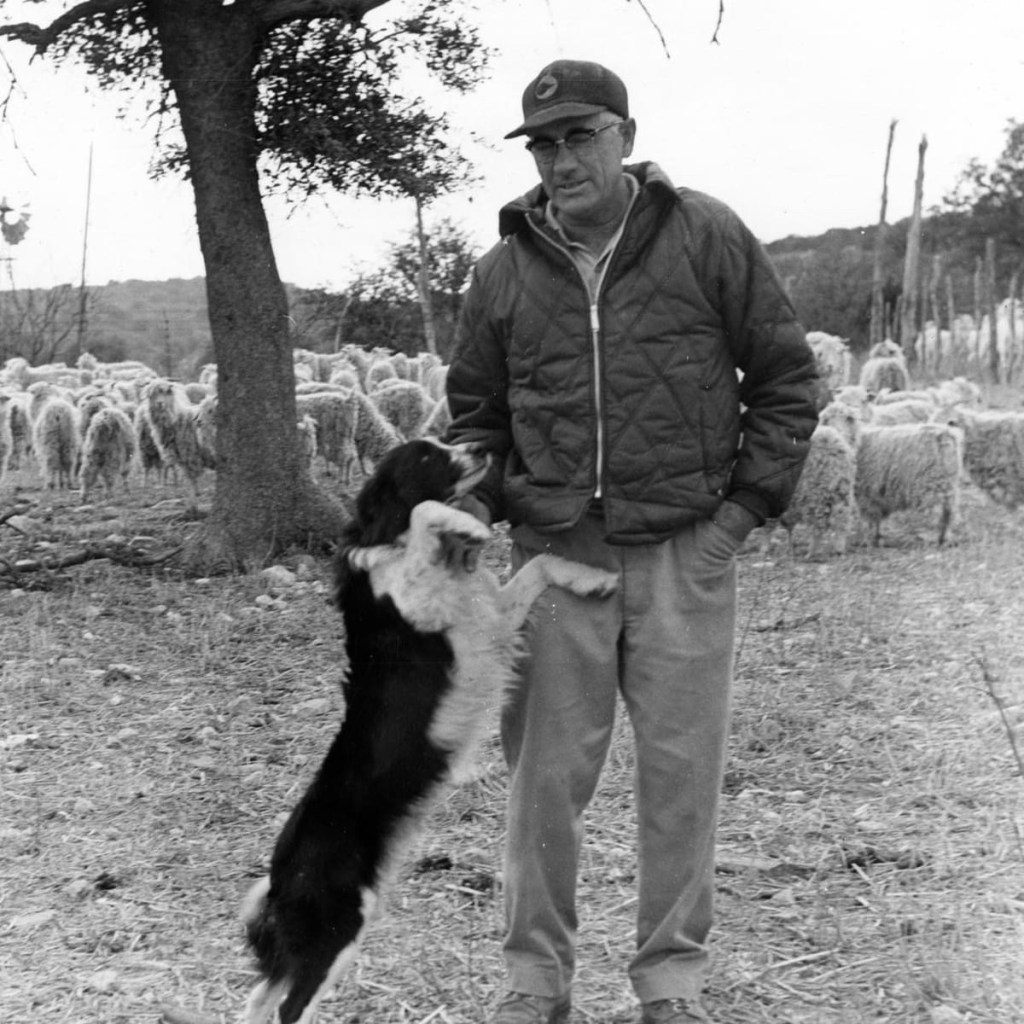
Arrott depends heavily on his Border Collie, now about 10, given him at about a year old by Kay Black, Ozona ranchman and dog breeder.
“You can turn the dog loose along a pasture fence, and he will go all the way around and· come back bringing nearly every goat in the pasture. He also is helpful around a shearing pen, but he tends to play the points a little too close in tight places,” Arrott says.
For about 10 years Arrott has used the same 15-man shearing crew of which Belio Villarreal, Rocksprings, is capitan. Shearing costs 30 cents a head this time, compared to 35 cents last fall. These shearing prices, too, are a far cry from the five cents Arrott paid to get the six-cent hair removed during the depression.
Arrott had rather see mohair bring a good price on its own merits than to have it subsidized through the incentive program, but he believes the incentive plan is essential to keep goat men in the business at today’s prices. “The incentive check just about pays the overhead.”
“Mohair, in my opinion, is the finest fiber there is, and it should sell for enough money to make goats pay their own way.”
Picture Cutline: SHEARING TIME for Monroe Arrott’s 7000 Angora goats doesn’t wait for fair weather. “You take the shearing crew when it’s available and hope the sheds protect the goats,” he says. He is shown with Pecos, the Border Collie he depends on for much help on the ranch.


 Angora Chronicles
Ronnie,
Reminds me of the old ranch I grew up on in Kimble County. The Angora goats kept us from going under in the 7 year drought during the 50’s. And we would have never made it without our Border Collie dogs….and I still subscribe to and read the Livestock Weekly. Don’t know where you come up with these pieces but you find some good ones.
LikeLike